- Journey plans make coverage measurable — we know who was supposed to be where before anyone reports what happened.
- Visits confirm within 20 metres of the outlet; a visit that can't verify its own location doesn't get logged as a visit.
- FEFO picking and digital proof-of-delivery close the last mile: the same rules, every route, every day, with a machine keeping the record.
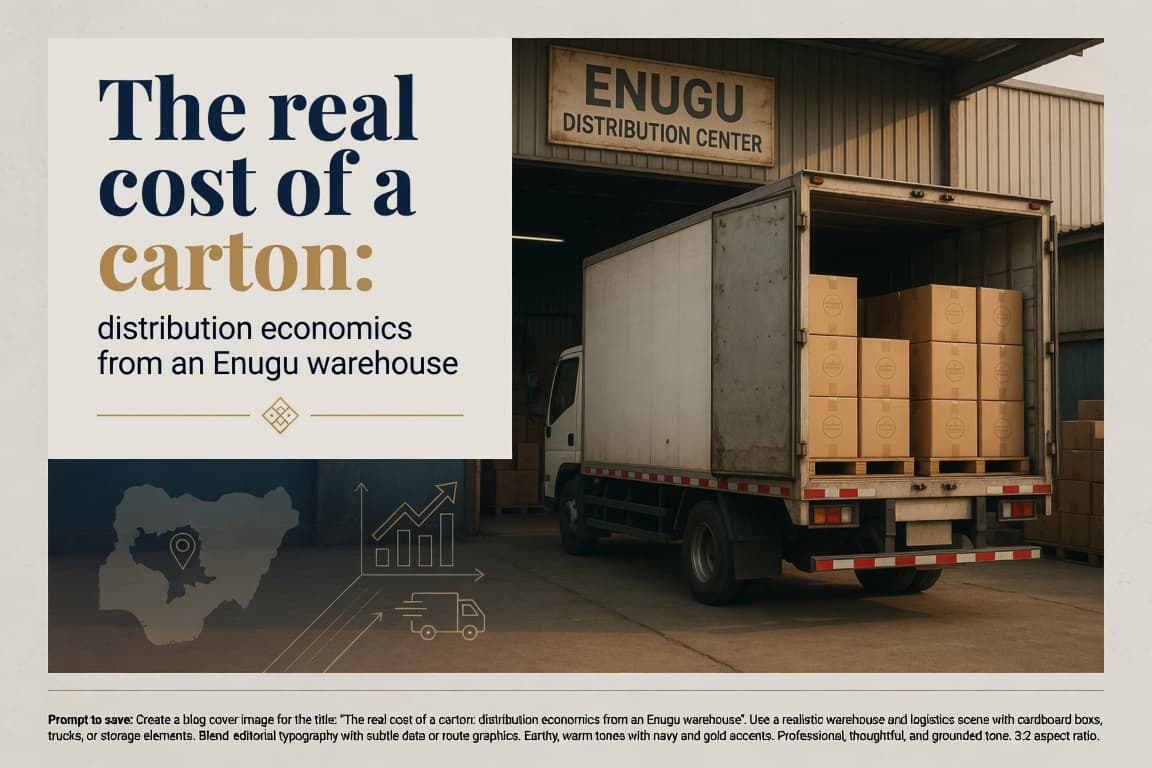
A carton of Chivita leaving the Enugu warehouse and a carton of Chivita landing on a shelf in Onitsha are, on paper, the same journey everyone in FMCG describes the same way: a route. In practice, the gap between those two points is where most Nigerian distribution actually breaks — and where it doesn't, at COJUDE, on purpose.
Route-to-market sounds simple until you've tried to run it at scale without software. A rep with a notebook can serve a shop. A rep with a notebook cannot prove, three weeks later, that the shop was actually visited, that the order matches what left the warehouse, or that the money collected matches either one. Multiply that across six states and hundreds of outlets and "simple" becomes the reason distributors lose stock, lose money, and lose the trust of the manufacturers who appointed them.
We built COJUDE OS to close that gap at every step, not just the visible ones.
It starts with the plan, not the visit
Every field rep works from a journey plan — a route of outlets assigned for that day, not a free-for-all. That single decision is what makes coverage measurable: we know who was supposed to be where, before anyone tells us what happened when they got there.
Proof, not memory
When a rep reaches a shop, the app requires a location check-in within 20 metres of that outlet before a visit can even begin. That number isn't arbitrary — it's tight enough to rule out "visited from the car outside" and loose enough to allow for real GPS drift inside a market. A visit that can't verify its own location doesn't get logged as a visit.
From there, the order itself is captured at the shelf, not reconstructed from memory back at the office. Stock checks, order lines and prices go in on the spot, on the same device, in the same motion as the sale. That's the difference between "I think we sold about forty cartons" and a number the warehouse can act on the same day.
The warehouse and the last mile
The warehouse side of the journey runs on its own discipline: FEFO, first-expired-first-out. For a portfolio that's mostly juice, dairy and malt — categories where a wrong picking order turns into real financial loss — FEFO isn't a nice-to-have, it's the difference between shelf-ready stock and a write-off six weeks later. Every pick, every dispatch, is checked against expiry, not just against quantity.
And then there's delivery — the part customers actually see. Every drop carries digital proof: a photo, a location, a timestamp, tied to that specific delivery.
None of this is glamorous. It's the boring, repeatable mechanics of a route done properly, at every single step, with a machine keeping the record instead of a person's memory. Five years and 475+ outlets later, that's the actual explanation for the number people find impressive: it isn't one heroic push. It's the same rules, followed on every route, every day, without exception.
That's the part that doesn't fit on a billboard — but it's the part that makes the billboard true.