- A carton's journey adds real costs at every step — transport, warehousing, capital, expiry risk, delivery — that someone must pay.
- Distribution margins are thin and earned in volume and discipline; the 'fat middleman' of legend rarely survives this trade.
- Suspiciously cheap stock hasn't escaped the cost stack — it has skipped something you'll pay for later: provenance, dates, or truth.
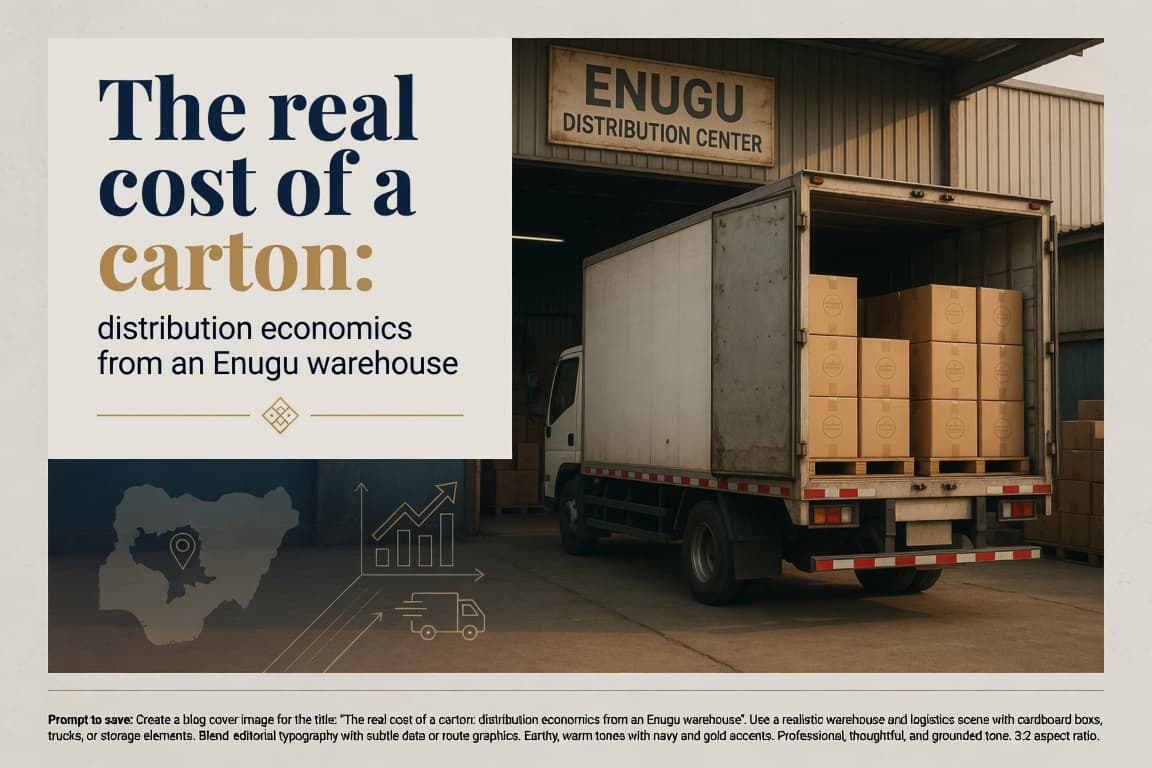
Why does the 'same' carton of juice have one price at the factory gate, another at the distributor, another in the market lane, and another on the shop shelf? The short answer is that it isn't the same carton anymore. Every kilometre and every day between the factory and the consumer, that carton consumes real money — and understanding what it consumes is the difference between negotiating wisely and just complaining about prices.
The cost stack, honestly
- Movement: fuel or diesel, vehicle wear, a driver's day — paid whether the road cooperates or not.
- Warehousing: rent, security, and the careful handling that keeps juice sellable — dry, rotated, intact.
- Capital: cartons are bought before they're sold; the weeks in between are financed by somebody, at Nigerian rates.
- Risk: expiry, damage, and the credit a trade partner may or may not honour — priced in, or paid for in losses.
- Service: the rep who visits, the delivery to your door, the receipt, the person who answers when something's wrong.
The margin myth
The legend of the fat middleman doesn't survive contact with a distributor's books. FMCG distribution runs on thin margins multiplied by volume; the profit is earned by moving many cartons efficiently, not by marking up a few extravagantly. A distributor who priced greedily would be undercut within the week — this market performs that correction with enthusiasm. What a fair distributor margin buys the system is genuine stock, availability, delivery, and someone accountable standing between the factory and the shelf.
Reading a 'too good' price
Stock dramatically below the market has skipped something: maybe provenance (you don't want it), maybe freshness (you'll write it off), maybe the seller's own arithmetic (they won't be there next month), maybe someone upstream was simply robbed. The carton's journey always gets paid for by someone — the only question is whether you pay in price, in losses, or in reputation.
From our side of the stack in Enugu: we publish consistent distributor prices to the shops we serve, deliver at our cost within our coverage, and put a receipt behind every carton — five years of that, 475+ outlets, and the arithmetic still works because volume and discipline carry it. That's the honest economics of this trade. Anyone promising you magic beneath it is charging you somewhere you haven't looked yet.